
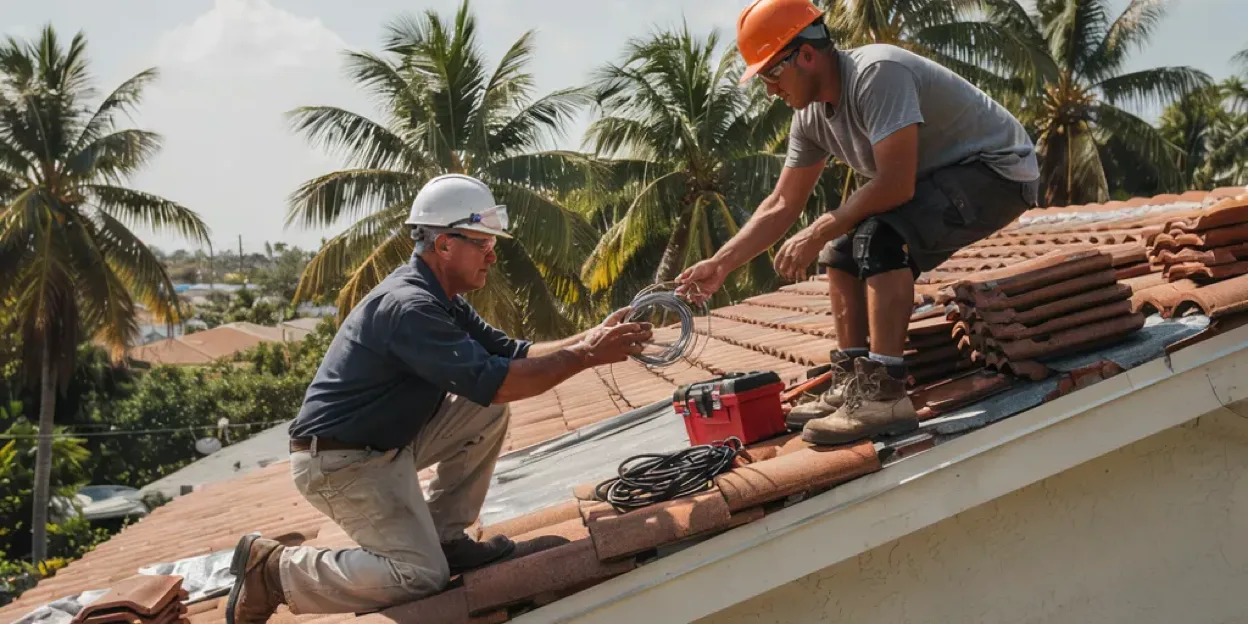
Burnt Store is the road and the communities along it: Burnt Store Isles inside Punta Gorda, a 1970s and 1980s canal community of tile-roofed homes with sailboat access to the harbor, and then Burnt Store Lakes, Burnt Store Meadows, and the newer subdivisions strung south along Burnt Store Road toward the Lee County line. The stock is mostly tile on block, hip roofs, and deed restrictions on profile and color.
The harbor is a mile west and open. Ian's eyewall crossed it on September 28, 2022, and the wind walked ridge tiles and cracked field tiles up and down the corridor. Many Burnt Store Isles roofs date to the post-Charley years and are now at underlayment age, so the community is getting insurer letters and storm damage at the same time.
This site connects Burnt Store homeowners by phone with an independent local roofing contractor. It does not do the work.
A tile roof from 2005 that an insurer is asking about is a roof inspection that lifts tiles and reports on the underlayment. Underlayment that is done is a roof replacement, often a lift-and-relay that keeps the tile the association approved. A post-2004 tile roof with straps and a sealed deck that has never been documented is a wind mitigation form waiting to be filed.
Burnt Store Isles is inside the city, so its roofing permits go through the City of Punta Gorda; the communities south along the road are unincorporated and go through Charlotte County Community Development. At the road's end, just over the county line, Safe Harbor Burnt Store is the marina that gives the corridor its boating traffic and a clear view of what salt does to metal over a decade.
Call (941) 294-6154 to be connected with a local roofing contractor serving Burnt Store.
A leak traced to its real entry point, then the flashing, boot, tile, or shingle that let it in put right and photographed.
Tear-off to the deck, new underlayment, and tile, metal, or shingle fastened to the Florida Building Code, with the county permit pulled.
A tarp on the opening before the next rain band, then photos and a written scope of what the wind took.
A walk of the roof and the attic side, with photos and a written condition report you can hand a buyer or an insurer.
The state OIR-B1-1802 form completed on your roof's straps, deck nailing, and water barrier, so your agent can apply the credits.
Dated photos, a line-item scope, and a contractor at the adjuster visit, so the claim is about what the roof shows.